
Eating, using up, wasting
Notes on consumption

This publication has lain fallow for many months while I cultivated other areas of my life. I moved, traveled, built relationships; I made a greater effort in therapy than I ever have before. And yes, I frequently gazed into a bright white screen, confirmed that I had no ideas and no motivation, and tabbed away. To coax myself back into my writing practice, I devised an exercise in which I pick a juicy word and chase it across my bookshelves.
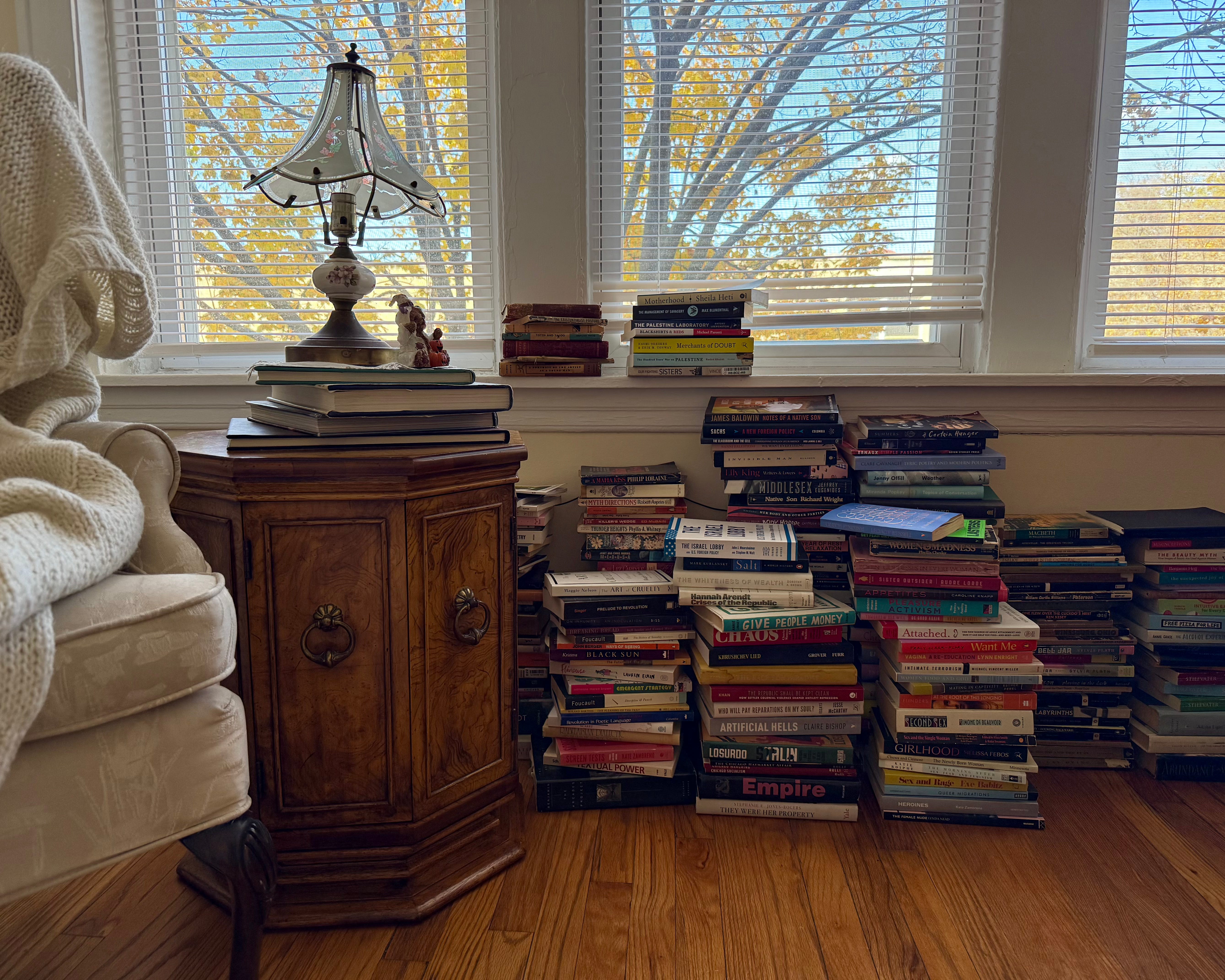
An ulterior motive of this exercise, assuming it succeeds in dislodging my writer’s block, is to begin compiling a Medusa’s Body bibliography rooted in terms and concepts that have recurred across essays. I’m starting with a word that has figured in almost every essay.
-
Consumption, noun, late 14th century: “wasting of the body by disease; wasting disease, progressive emaciation,” from Old French consumpcion, from Latin consumptionem: “a using up, wasting;” noun of state from past-participle stem of consumere: “to use up, eat, waste.”
-
“Loss cuts into what we own like rot into an apple. Possession contradicts consumption: on earth, we are not permitted to conserve and consume at once.”
Becca Rothfeld, All Things Are Too Small
Accusing someone of wanting to have their cake and eat it, too, is an accusation of wanting to both accumulate and consume nice things, to put them on display and to make them disappear into some dark slimy inside. We understand that doing both is impossible, so we are forced to choose whether seeing or tasting will serve us more.
-
“Veal, chicken, / lamb chops & calamari / Who will be served / by my death”
Francesca Kritikos, “Menu” from The season of lilacs is monstrous
-
“If we were still talking the language of the fourteenth or even seventeenth centuries, a ‘consumer society’ would have meant a society of wastrels and destroyers.”
David Graeber, “Consumption” in Current Anthropology
Instead, many contemporary “consumer goods” are never destroyed, unless we consider the slow shedding of microplastics destruction, but rather removed from our sight when we tire of them. Consumption today is about adornment rather than the pleasure of destroying something by ingesting it or using it up. Market value rather than use value. What is wasted is water, what is destroyed is somewhere else.
-
“The Imperial Mode of Living refers, essentially, to the societies of the Global North that rely on large-scale production and consumption. This is what makes our rich lifestyles possible. Beneath this surface, there exists a structure by which the cost of our consumption is extracted from the lands and labor of the people of the Global South. […] We experience this way of life as desirable, though, and are loath to give it up. If we were to acknowledge the state of things in the Global South, we would be forced to lower our own standard of living. Our way of life is, in fact, a terrible thing.”
Kohei Saito, Slow Down: The Degrowth Manifesto
-
“Neoliberalism makes citizens into consumers. The freedom of the citizen yields to the passivity of the consumer. As consumers, today’s voters have no real interest in politics — in actively shaping the community. They possess neither the will nor the ability to participate in communal, political action. They react only passively to politics: grumbling and complaining, as consumers do about a commodity or service they do not like.”
Byung-Chul Han, Psychopolitics: Neoliberalism and New Technologies of Power
-
“Social media is awash with the idea that ‘it’s valid not to be productive’, as though productivity were the only manifestation of capitalism and streaming Disney+ all day is a form of resistance. It’s much rarer to encounter the idea that we have a responsibility about what we consume, or that satisfying our own desires whenever we want is not always a good thing: ‘there is no ethical consumption under capitalism’ has morphed into ‘there is no unethical consumption under capitalism.’”
James Greig, “Everyone Needs to Grow Up” in Dazed
-
“In 2023, an article in Scientific Reports presented data suggesting people on Ozempic might be reducing their alcohol intake — not just their total calories. A 2024 article in Molecular Psychiatry found that the drug might positively impact cannabis use disorder. Here’s an article from Brain Sciences that suggests the drug reduces compulsive shopping.
A picture is starting to form. A picture that suggests these drugs curb hunger both literally and figuratively. That GLP-1 receptor agonists like Ozempic and Mounjaro are fundamentally anti-consumption drugs. And in a society that, some would argue, is plagued by overconsumption — well these drugs might be just what the doctor ordered.”
F. Perry Wilson, “Ozempic curbs hunger… but not just for food”
-
“Illnesses have always been used as metaphors to enliven charges that a society was corrupt or unjust.”
Susan Sontag, Illness as Metaphor
-
“Feeling hungry? Here, nibble on Hailey Bieber. Really — it’s fine! ‘I want someone to want to take a bite out of my skin,’ the model and beauty brand founder said in an interview with New York Magazine earlier this summer. ‘I want you to want to bite me because it looks so delicious that you can’t resist.’
Bieber is hardly alone here. A glut of recent beauty trends offer tips on looking less like you and more like a variety of foodstuffs: dewy dumpling skin, Jello skin and, Bieber’s personal go-to, glazed donut skin. (There’s even Saran Wrap skin if you want to save yourself for later.) While there are slight differences among them — Saran Wrap skin focuses on eliminating texture, jello skin on adding bounce; dumpling skin aims for dewiness, glazed donut skin for full-on gooeyness — all share the same core aesthetic: impossibly smooth, inordinately shiny and ultimately inhuman.
This urge to replace what is living and inevitable (pores, pigmentation, wrinkles, blemishes) with what is inanimate and ingestible (flour, frosting) isn’t so surprising, really. It’s in line with decades of unrealistic beauty ideals, which exist to service ‘a secular society’ that worships ‘ever-increasing industrial productivity,’ Susan Sontag writes in On Women. The philosopher describes a sort of self-objectification that isn’t concerned with appealing to men, but rather, with deifying and even identifying with products.”
Jessica Defino, “Hailey Bieber’s Flesh-Eating Empire” in Flesh World
-
“People who starve themselves amidst abundance, once called misers, are now labeled anorexics, considered mentally ill, and are sent off for treatment. Anyone who would voluntarily choose poverty is someone who will allow their children to go hungry when good food is put before them; insane if not criminal. As long as Consuming Is Eating, it is hard to imagine any mass movement towards metaphorical anorexia.”
Richard Wilk, “Morals and Metaphors: The Meaning of Consumption” in Elusive Consumption
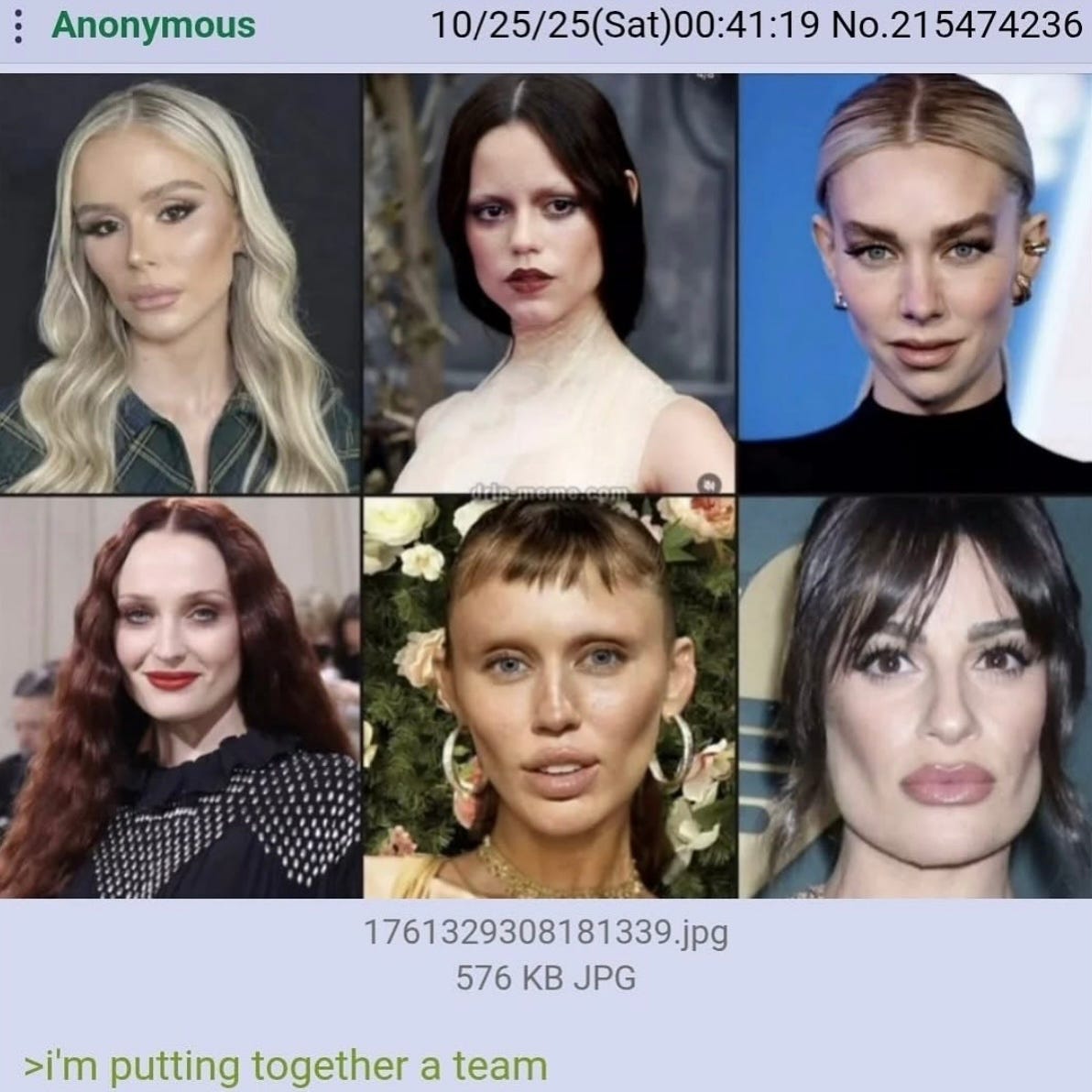
Wilk wrote his analysis of the consumption metaphor in 2004, before GLP-1s. The rise of GLP-1s as a consumer product in parallel with their use as a medical product has confused the Consuming Is Eating metaphor and the metaphors that follow from it, Wealth Is Fat and Poverty is Starvation. It used to be fat kings and thin paupers, now celebrities are upsettingly gaunt and obesity is strongly associated with low income.
-
Between 1780 and 1850, consumption caused around 25 percent of deaths in Europe, but since it happened to align with the racialized beauty ideals of the time (visible collarbones, sunken cheeks, ghostly pale skin), the wasting disease was glamorized in popular culture. The process of dying actually conferred beauty.
Sabrina Strings writes in Fearing the Black Body: The Racial Origins of Fat Phobia that voluptuousness was an essential aspect of European beauty during the Renaissance, but by the end of the 18th century, “it was becoming part of the general zeitgeist that fatness was related to blackness,” Strings writes, with fatness being “treated as evidence of barbarism.” (I wrote a whole essay on this book — check it out, or better yet, buy the book.) In a healthy society, voluptuousness signifies material abundance, but in our society sick with atrophied puritan values and racial defensiveness, beauty is an expensive performance of scarcity. Better to look and feel and almost be dead than to look like the hemispheric Other who bears the brunt of our consumption, who we prefer not to think about.
-
“Consumer dreams never come true.”
Kohei Saito, Slow Down: The Degrowth Manifesto
-
“We want to get behind the beauty, but it is only a surface. It is like a mirror that reflects to us our own desire for good. It is a sphinx, an enigma, a sorrowfully irritating mystery. We want to feed on it, but it is only an object we can look on; it appears to us from a certain distance. The great sorrow of human life is knowing that to look and to eat are two different operations. Only on the other side of heaven, where God lives, are they one and the same operation.”
Simone Weil, Waiting for God
I loved this. Funnily enough, I wrote a poem yesterday focusing on gluttony and the all-consuming nature of our society. It’s like channeling the same spirit through inverted lenses, maybe it’s the energy of the season. I visualize this concept as the snake eating its own tail.
This is fantastic! Saved it to go through your source material myself. Thanks!