
Throwing Open The Door
revelation, intimacy and horror in the era of injectables

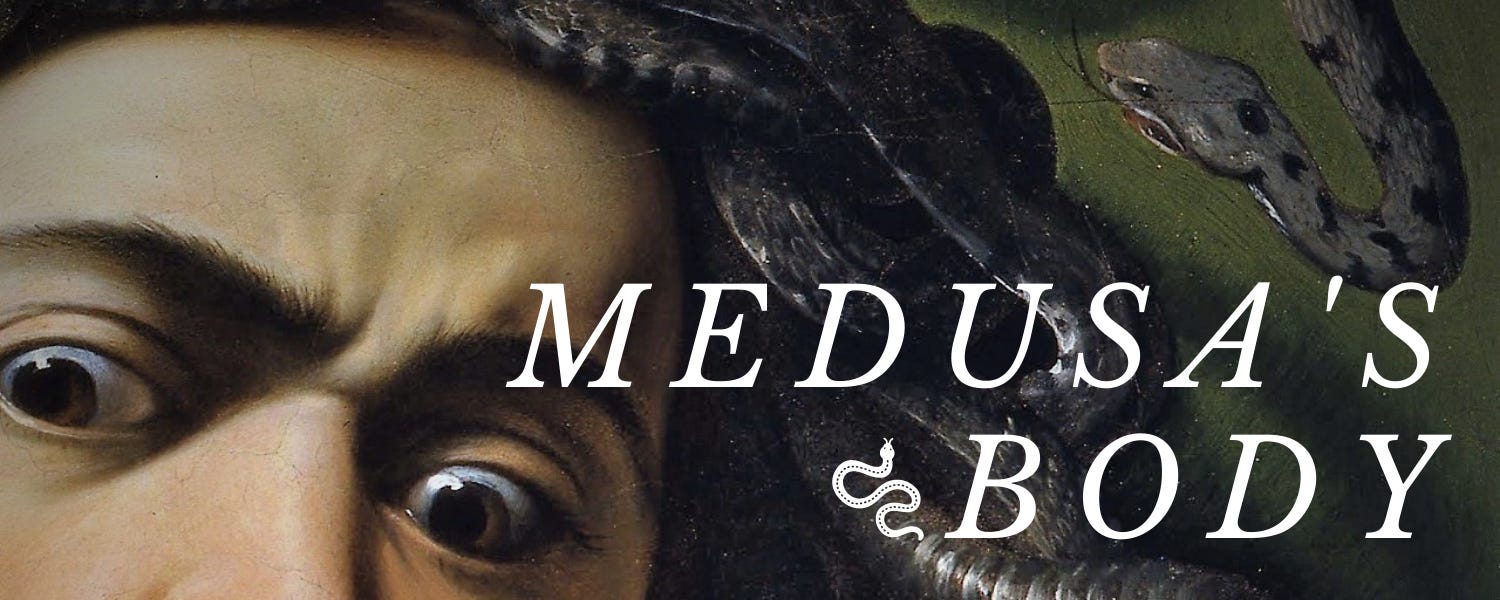
In a nightmare, I watch with horror as a man walks toward a door, the door to my bathroom, behind which I am standing in my true form, monstrously hunched, hideously scowling. I am desperate to snatch the man away from the door or yell stop! don’t! but my arms do not move and my mouth does not open. When I wake, I walk to the full-length mirror in my bedroom and regard myself with a kind of pity I never felt before.
-
Splitting is a term in psychodynamic theory that refers to the tendency to form cognitive representations of the self and others that are either all-good or all-bad. Splitting is a defense mechanism that simplifies the complex spectrum of human traits into two clear categories in order to reduce the anxiety that comes with ambiguity.
-
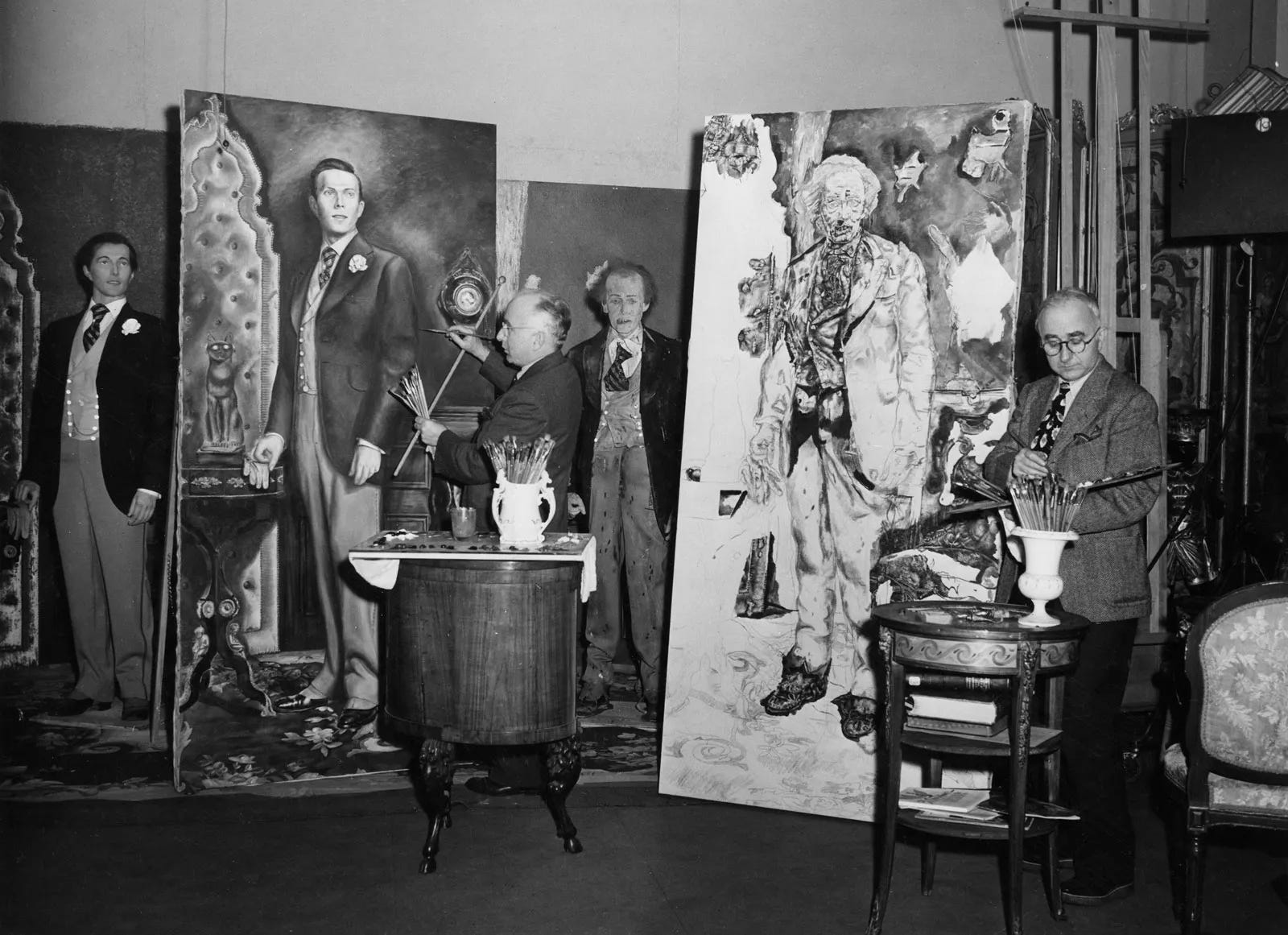
In The Picture of Dorian Gray by Oscar Wilde, the titular character makes a Faustian pact to stay young and beautiful forever. His inability to integrate his own mortality causes him to split: The weathering of his flesh by time and mangling of his soul by sin are inscribed on a life-sized portrait instead of him. As Dorian gives in to a life of vice, he hides the decaying portrait in the attic, desperate to maintain his cover of beauty. Ultimately, the monstrosity of the portrait transfers to him, a lethal reunion of ideal self and mirror self.
Ivan Albright’s Picture of Dorian Gray, the painting commissioned for Albert Lewin’s 1945 film adaptation, is in the Art Institute of Chicago’s permanent collection, so I’ve probably seen it ten times. Each time, I experience a miniature version of that climatic scene in the film, the fanfare of horns and splash of technicolor that jars even a 21st-century viewer. I round the corner and the painting peels into my peripheral vision and braaaap, the confrontation.
I would blame Wilde and Albright and Lewin for my nightmare, but I’m not that vain, and I don’t have an attic.
-
In The Substance, the 2024 film by Coralie Fargeat, Elisabeth Sparkle splits. Unable to accept that her changing appearance will end her acting career, Elisabeth locks herself in her bathroom while a younger, hotter double steps out of her body, a macabre Birth of Venus, and faces the world for her. The original self, like Dorian’s cursed portrait, keeps the score: Elisabeth perceives herself as ugly at the start, but she becomes truly monstrous over the course of the film, a consequence of her ideal self not giving equal time to her mirror self.
In both films, neither self is the true self. The real is somewhere in between. If Dorian and Elisabeth could accept that beauty changes with time and smooth skin isn’t worth a deal with the devil anyway (the devil being the beauty industry in the latter case), there would be no monstrous transformation. Reaching for the ideal causes the perception of the real to move in the opposite direction. But nature has no need for opposites; human reality is that ambiguous space of change and subjectivity between heaven and hell.
-
Ancient and nonwestern religions are populated with feminine figures who transcend simple binaries. The Great Mother archetype, as Jungian analyst Erich Neumann argues, is the primordial feminine representation of both nurturing creation and destructive chaos, visible in figures such as Isis, Kali, Demeter and Mother Nature.
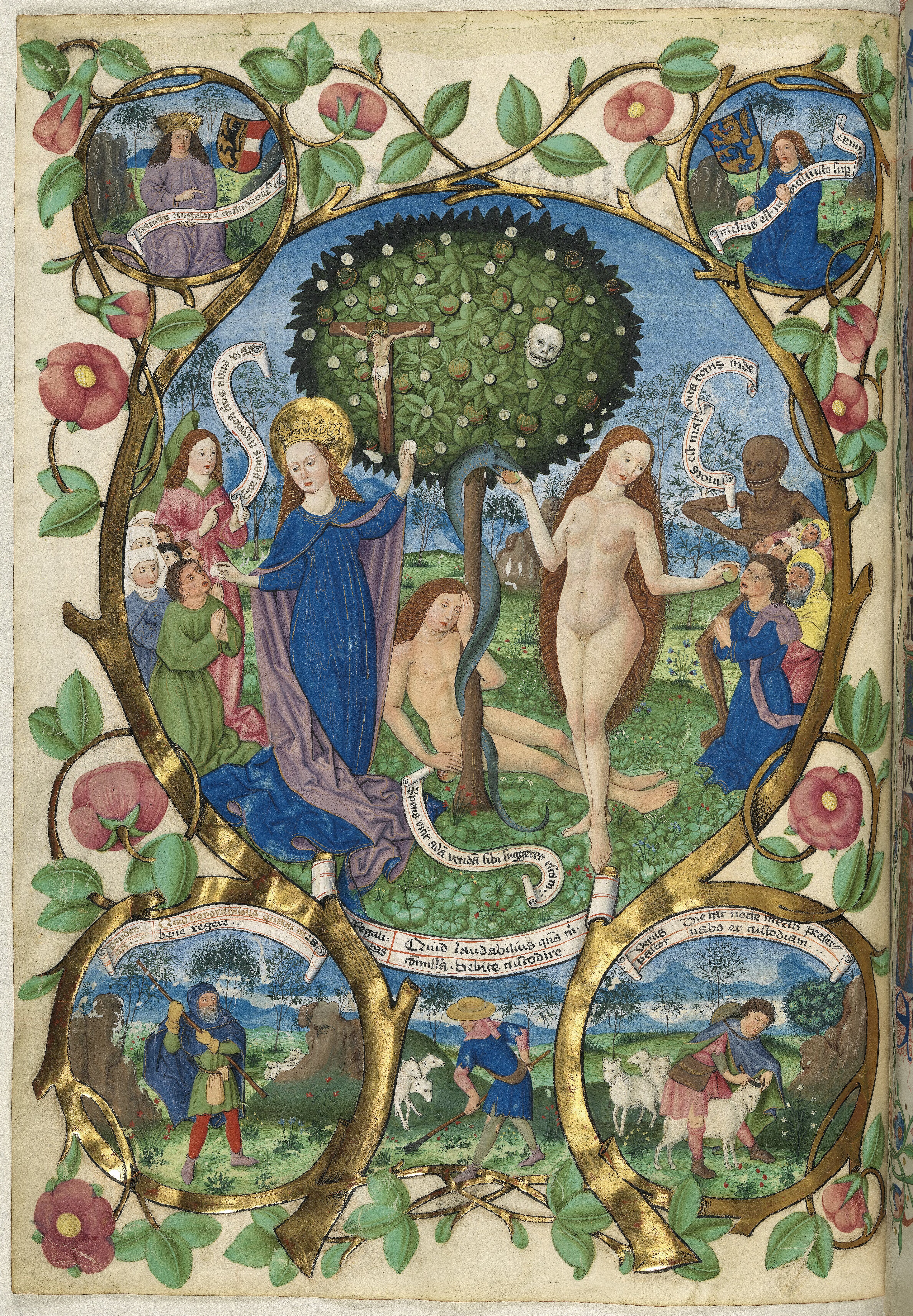
As a universal mother with a hunger for knowledge of both good and evil, Eve bears a resemblance to this archetype. Eve was cast down as a sinner for her hunger, while Mary—called New Eve by devotees beginning in the second century—was lifted up as a redemptive feminine figure. The above image, a 1481 manuscript illumination by Berthold Furtmeyr called The Tree of Death and Life, illustrates the contrast between these two mothers: Eve is the “mother of all the dead,” bearing sin and death into the world, while Mary is the “mother of all the living.”
Christianity, the western cultural influence of which cannot be overstated, split the abundant wholeness of woman into two women, one good and one bad. One is naked and sex-having and “natural,” and the other is a rejection of nature for the godly. This split has stayed lodged in the collective unconscious, bubbling up as the belief that we should seek out, pathologize and banish negative aspects of ourselves (often just natural things like aging and appetite and the need for rest), lest we be marked as negative.
As our culture moves away from institutional religion, the good versus evil binary is covered over with others, such as dirty versus clean, healthy versus sick and beautiful versus ugly, but the intensity of religious value/virtue binaries is still embedded in how we judge ourselves and each other. This, I fear, is why my unconscious mind is afraid that a man seeing me in my messy bathroom with greasy hair and uncovered acne and an un-sucked-in stomach would cause him to discover that I’m not only an undesirable woman but a bad one, too.
-
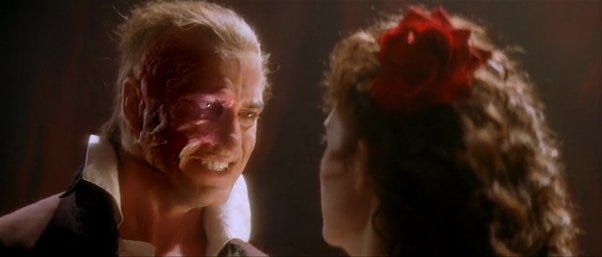
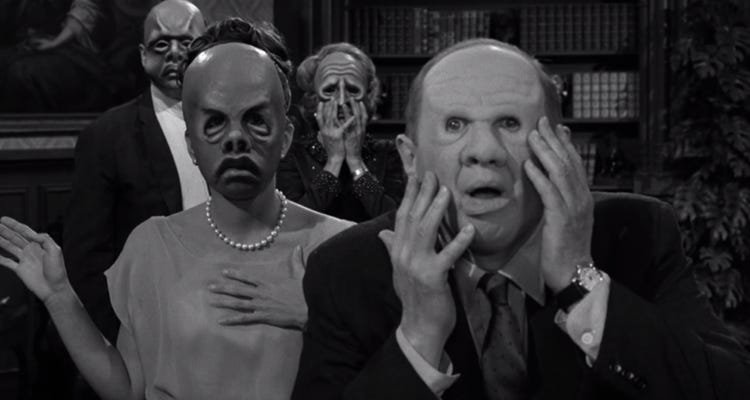
In film, what is hidden behind closed doors must be revealed. Revelation is a fundamental driver of narrative because it is a fundamental driver of relationship. The sharing of emotions, histories, difficulties and dreams is seen as a requirement for deep bond formation, so we tell stories that reflect the anxiety of being exposed, the courage it takes to be honest, and the ecstasy of finally being known. The onscreen and IRL uncovering of bodies reifies the vulnerability (and danger) of revelation.
-
The beauty industry capitalizes on our fear that letting our guard down would lead to rejection or injury, selling us the safety of having nothing to reveal. If your Instagram face is still there after you wash your makeup off, you won’t need to worry about the judgment of that man outside the door. Deeper and more permanent methods of manipulating our appearance allow us to believe that we can transform into the ideal instead of just enhance the natural. In The Substance, the way a young woman bursts out of Elisabeth’s body literalizes the transformation fantasy we are constantly being sold: Reverse aging on a cellular level. Disappear for three months and become unrecognizable. What they’re selling is a split that alienates us from ourselves.
Do I think we’re signing a deal with the devil when we shop for skincare? Not exactly. I do think that investing in beauty ideals erodes our perception of our natural faces and bodies. (The more we want to look young, the more we associate “looking our age” with looking terrible. The harder we try to be thin, the more we associate our set-weight with being out of control.) Most importantly, the work we do to keep the natural under wraps can leave us and unprepared to cope when the world shows us real chaos.
-
In an essay called “I want to know my face,” Harriet Hadfield discusses the normalization of beauty procedures like Botox and filler and the terrible question, do I have the courage to love myself if I don’t get work done?
People have said to me, ‘but you wear makeup, you wear moisturizer’, but both of those I can take off. I have the ability to reveal my face. A lot of my friends confessed getting botox was a trial thing where curiosity got the better of them. But at least 95% of those who were just curious, couldn’t not get it again.
I have the ability to reveal my face. I have the ability to reveal my face. When I read this, my stomach twisted as I realized that keeping the ability to reveal my face means signing up to experience the anxiety (and joy, thank god) of revelation over and over and over again. I will allow the door to be opened, because I have not let the world convince me that there’s a monster behind it.
I am certain that in a few years, not getting injectables while being visibly not young will be looked down upon the same way not trying to lose weight while being visibly not thin is looked down upon today. Keeping the ability to reveal my face is a political and economic choice for me, and I think it’s also a therapeutic one. Facing my face, as practice for facing all the rest.
"I have the ability to reveal my face. I have the ability to reveal my face. When I read this, my stomach twisted as I realized that keeping the ability to reveal my face means signing up to experience the anxiety (and joy, thank god) of revelation over and over and over again. I will allow the door to be opened, because I have not let the world convince me that there’s a monster behind it." :''''''')
“Reaching for the ideal causes the perception of the real to move in the opposite direction.” Beautiful. It requires some enlightenment, acceptance and ability not to place all our self worth into our appearance. That “ideal” is a moving goal post. Impossible to achieve. And not necessary to give in to others setting the standards for us. I, for one, age 54, am not giving in to it. I am vain. But I cultivate other things that make up my whole. Beauty is just one part. So as it “goes”, I have some other stuff going for me.